Cima Provides Medical Care to a Mennonite Family
The Dog StarsCima’s visit to the Mennonite community turns a boundary maintained by fear into a place of care. She crosses the quarantine line, introduces herself as a doctor, and examines residents whose illness and visible weakness had kept other people away. Her work does not cure the community’s blood disease, but it offers immediate treatment and companionship while revealing the cost and consequences of the warning that had protected them.
Background and the Quarantine
The community consists of roughly thirty Mennonites living south of Hig and Bangley’s position. Hig understands their illness as a blood disease that appeared after the flu: it affects children as well as adults, leaves people sick and weak, and is followed by deaths every year. His estimate that it may be AIDS-like, and perhaps more contagious, is uncertain; the account distinguishes that early fear from the later explanation Cima gives of how the disease is transmitted.
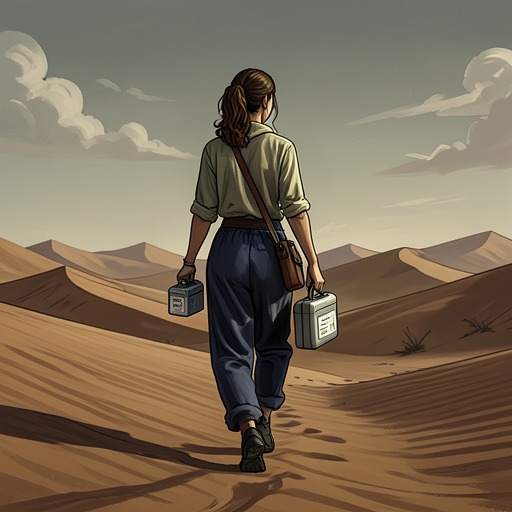
Cima’s medical background matters before she begins treating anyone. When asked what kind of doctor she is, she identifies herself as an internist with a public-health background. That combination is pertinent to a community living under quarantine: her role is not only to attend to individual injuries and illness, but also to understand contagion and the beliefs governing contact. Hig’s account establishes that he and Cima had discussed the disease before the visit, so her crossing is not based on ignorance of the risk.
The warning signs around the edge of the community’s fields declare THE BLOOD. The fear those signs provoke has helped keep attackers away, but the barrier also leaves the residents isolated. From a distance, their wasted appearance and exhausted movements make their illness visible without explaining it. Cima’s visit brings that distant picture into direct human contact: the people behind the warning are patients and neighbors, not merely a danger to be avoided.
Crossing the Boundary
After Hig lands with Pops, Cima wants to visit the families and brings her medical bag. They land on the farmhouse drive. Residents gather from across the settlement; some run toward the arrivals, while others can barely walk. Hig watches their expressions change as Cima approaches. Their surprise and curiosity register the force of a stranger arriving not to threaten them but to come near.
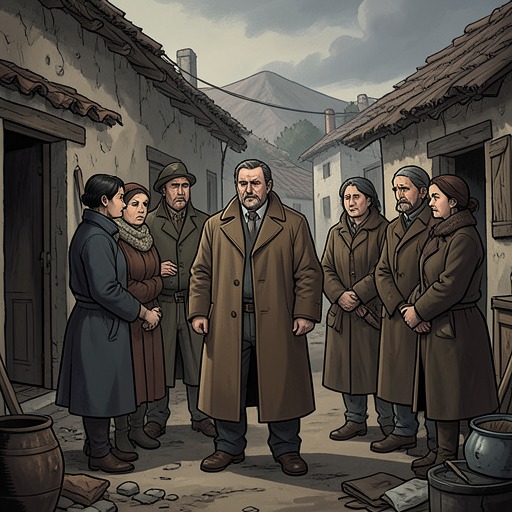
Cima steps across the DMZ. The residents recoil slightly and leave space around her, a collective hesitation that makes the quarantine line legible as a social boundary as well as a precaution. She raises a bruised hand to reassure them. Her assurance that she is a doctor cannot, by itself, undo the fear, but she smiles and gives her name. The scene’s change comes through presence and gesture before it comes through treatment: the people who had remained separated begin to gather around her.
Children reach for Cima and cling to her skirt. One little girl, identified uncertainly by Hig as Lily, holds her leg. Cima greets the children and asks their names. Hig sees in this welcome the return of ordinary touch for people who had been treated as untouchable. He remains worried about the possible consequences of contact, but recognizes that the encounter has already changed the community’s response to her. The frightened space around Cima closes into a circle of attention and trust.
Medical Work in the Farmhouse
Cima sets up in a room of the old farmhouse that Hig describes as its parlor. Wearing latex gloves, she examines the residents one by one, opening the door to the kitchen to call in the next person. The sequence is practical and sustained rather than ceremonial: she sews up cuts, dresses wounds, and asks for buckets of warm water. Her medical bag contains gloves, and she uses them as she works.
Her care also includes attention to needs that are not reducible to a wound. She counsels a young woman who is six or seven months pregnant and comforts an older man whose weeping Hig can hear from outside the kitchen door. The visit therefore encompasses examination, basic treatment, reassurance, and emotional support. Cima attends to individuals while moving through a community whose illness has made routine care and physical contact unusually difficult.
As the examinations proceed, Cima tells Hig that he can cross and mingle with the residents: their understanding of contagion is mistaken. She compares the disease’s transmission to Hep C and to HIV as it was once understood, explaining that it involves bodily fluids and blood rather than casual proximity. This distinction clarifies why her visit is possible without claiming that the illness is harmless or that the residents no longer need precautions. The evidence establishes the route of transmission as Cima explains it, not a cure or a complete resolution of the community’s condition.
Consequences and Significance
The warning that kept the Mennonite community apart had a double effect. Its frightening message deterred attackers and, in that sense, helped preserve residents’ lives. At the same time, the disease continued to kill them. The protection offered by their isolation was therefore real but incomplete: it guarded against outside violence without stopping the illness within the settlement. Cima’s crossing challenges the social consequence of that defense by showing that contact and care can be approached with medical understanding rather than fear alone.
The account places this visit within a wider uncertainty about the pandemic and its aftermath. When Hig asks how the flu began, Cima distinguishes the public account of a mutation involving a superbug and bird flu from rumors about its origin at Livermore and a military courier flight said to have crashed in Brampton. The narrative leaves the origin unresolved. Cima later refers to studies suggesting that the onset of the autoimmune disease was accelerated by the body’s impaired ability to make vitamin D, while presenting the proposed mechanism as curious rather than settled. These explanations provide context for the world the family faces, but do not turn the farmhouse visit into a definitive account of the disease’s cause.
Hig and Cima fly back in silence after the treatment. The scene’s lasting consequence is not a reported medical recovery, but a changed relation to the quarantined community: Cima has entered its boundary, treated its residents, and been met by their approach rather than continued separation. Her medical work gives practical form to the difference between contagion and stigma, while leaving intact the danger, uncertainty, and recurring loss that make the settlement’s isolation understandable.